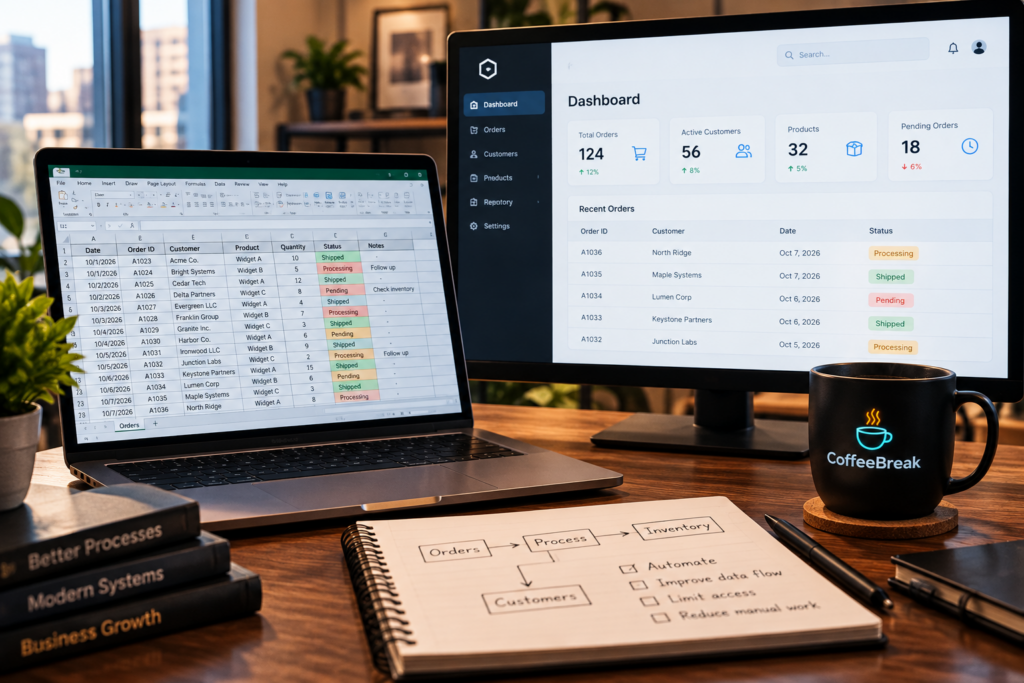
Imagine a small company where orders, schedules, and customer details all live in one spreadsheet. Years ago, someone built it to solve a simple problem. It worked, so people kept adding to it.
Now one person understands how it all fits together. When that person takes a week off, work slows down, and everyone hopes nothing breaks until they return.
If that sounds familiar, you are not alone. It is one of the most common ways a business ends up depending on something it never meant to depend on.
Spreadsheets are not the problem. They are often the right first tool. They are fast, flexible, and easy to change, and they are how many good processes get discovered in the first place. The question is not whether to use them. It is whether yours is still doing the job you need it to do.
Here are five signs it may be time to take another look.
- Only one person understands it. If the logic lives in one person’s head, the business carries a risk that is easy to overlook until it matters.
- People copy data between files or systems by hand. Every manual handoff is a chance for something to be missed, retyped, or put in the wrong place.
- Errors are caught after the fact. A spreadsheet will let anyone type almost anything anywhere. When mistakes are found only after they cause trouble, the process is relying on luck.
- Access is all or nothing. Sometimes people need to see or change only part of the data. If the choice is to share everything or share nothing, that is a sign the tool has outgrown its role.
- Reporting takes days of cleanup. If getting a clear answer means days of fixing and reconciling, the spreadsheet is costing more than it saves.
One or two of these does not mean you need new software. Several of them together usually means the process has grown past the tool.
The good news is that you do not have to replace everything at once. A practical path often starts smaller. Keep the spreadsheet as the place people already work. Put a database or an API behind it so the data has a proper home. Then automate the riskiest handoff first, and move from there.
Before anyone builds anything, a few decisions are worth making. Who owns the data? What are the exceptions, the cases that do not fit the normal process? And what does “done” look like? Teams that answer those questions early tend to make better choices later, whether they build something custom or not.
At Transcendent Software, we help Kansas City businesses sort out exactly this kind of problem. Sometimes the answer is custom software. Sometimes it is a smaller fix, and we will tell you that too.
If you want a quick way to start, take your most important spreadsheet and check it against the five signs above. Then tell us what you find. Start a conversation, or reply with the part you are least sure about moving off the spreadsheet.