At Transcendent Software, we routinely hear from companies that know AI will play a role in reaching their business goals.
The reasons are all over the place, but the pattern is remarkably consistent. A company sees the potential, buys a tool or starts building something, and expects momentum to follow. Then the organization discovers that access to AI is not the same as adoption.
The license is active. The prototype runs. The model can produce an answer. But the business has not yet turned any of that capability into a dependable way of working.
We tend to see three versions of this problem.
Automation in Search of AI
The first company is usually trying to reduce operating cost or remove a manual bottleneck.
Manual work becomes expensive as a business grows. More transactions require more people, more coordination, and more opportunities for errors or delays. Experienced employees are valuable precisely because they understand the exceptions, the customer history, and the judgment calls hidden inside the process. The goal should not be to discard that knowledge. It should be to stop spending so much of it on repetitive work that software can handle more consistently.
This problem did not begin with generative AI. We have been modernizing systems, integrating software, and automating operations for decades.
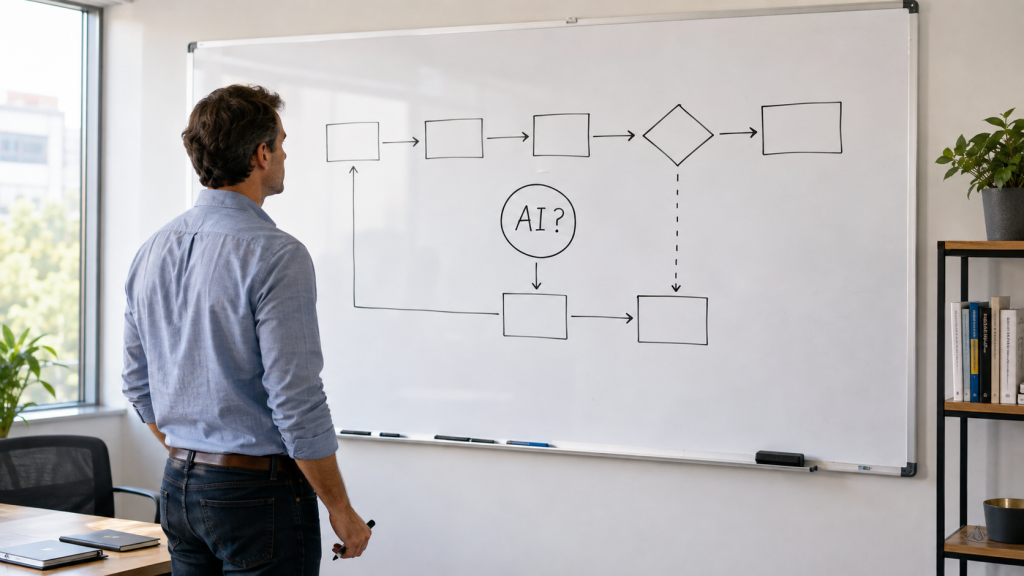
Many workflow steps are still best handled with deterministic software. A known input follows a known rule and produces a predictable result. AI becomes useful around the messy edges: extracting meaning from inconsistent documents, classifying information, drafting a response, surfacing an exception, or helping a person evaluate something that does not fit a clean rule.
That does not mean AI should replace the process. It means AI can support the parts where traditional automation becomes brittle, while clear rules and human review continue to control the parts that need consistency or accountability.
If a company starts with the instruction to ‘use AI,’ it may buy an impressive tool and still leave the original operational problem untouched. Adoption begins by understanding the workflow first.
The AI-Built Product Reaches Its Edge
The second company has already used AI to build something.
A founder or internal team has vibe coded a working application and accomplished far more than they could have without AI assistance. That is real progress. AI has lowered the barrier to turning an idea into software, and it is giving more people a chance to test ideas that might never have made it past a notebook or spreadsheet.
Eventually, though, the project reaches a point where the builder realizes they have something they do not fully understand. More importantly, they do not know what they do not know.
The application may work in the happy path while still hiding questions about authentication, exposed secrets, duplicated logic, testing, deployment, data handling, pricing rules, failure recovery, or long-term maintainability. The challenge is no longer getting AI to generate another feature. The challenge is seeing around corners the original builder did not know to inspect.
That is not evidence that the experiment failed. It is the natural point where an accessible building tool meets the need for experienced engineering judgment.
Adoption at this stage means turning AI-assisted progress into software the business can understand, operate, support, and trust.
The Licenses Arrive Before the Operating Plan
The third company knows AI should empower its workforce but cannot get traction.
Leadership may not know where AI fits, or it may have a reasonable idea but lack the people and time needed to put it into practice. The company buys licenses because that feels like forward movement. A few months later, it has mostly added another bill.
Usage often tells the story. One or two power users push the tools hard and may generate significant overage costs. Meanwhile, the company continues paying for 50 or 100 seats with little or no regular use. Even then, leadership may not know whether the heavy usage created meaningful business value or simply generated more activity.
That is not winning. It is access without an operating model.
People need more than a login. They need a useful workflow, permission to change how the work is done, training that reflects their actual responsibilities, clear boundaries, and a way to report when the tool is wrong or quietly creating more work.
They also need a reason to participate. Employees may reasonably wonder whether they are being asked to improve their work or train their replacement. Managers may see potential but lack the capacity to redesign a process while still delivering this quarter’s commitments. IT may be expected to lead adoption without being given the mandate, budget, or staffing to do it.
Those are not software-installation problems. They are operating and leadership problems.
What Adoption Actually Requires
Real AI adoption starts with a business problem and a workflow worth improving.
The organization needs to understand what happens today, where work slows down, which decisions require judgment, what information the system needs, and who owns the outcome. It needs to decide which steps should remain deterministic, where AI can help, where a person must review or approve, and how the system will be measured after it starts running.
The technical work matters. So do training, incentives, governance, cost control, feedback, and trust.
A useful adoption plan should be able to answer a few basic questions:
- Which business outcome are we trying to improve?
- Where does AI belong in the workflow, and where does it not belong?
- Who owns the system and the result?
- How will employees learn, challenge, and improve the workflow?
- What will tell us that the system is creating value instead of merely creating usage?
Buying the tool may be part of the answer. It is rarely the whole answer.
Transcendent Software helps companies move from technology interest to working systems. That may mean modernizing an existing platform, automating a repetitive operation, reviewing an AI-built application, designing a governed AI workflow, or providing the technical leadership needed to move the effort into real operations.
CoffeeBreak is the AI orchestration platform we are building around where this work is heading. It is designed to coordinate models, tools, memory, policy, and people across long-running work. Through Transcendent Software, we help businesses solve the practical problems in front of them now while applying the same orchestration principles to systems that have to work in the real world.
If your company has purchased AI tools but cannot yet point to a workflow that is measurably better, or if an AI-built solution has reached the point where it needs experienced eyes, it is worth a conversation.
Let’s look at one real workflow, find where the value is hiding, and build the operating path that turns access into adoption.