
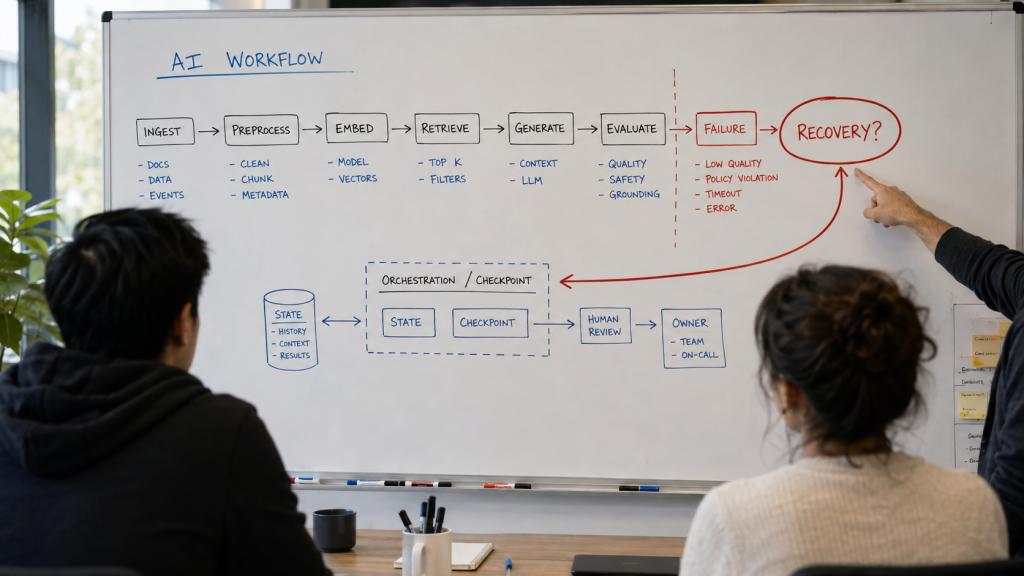
The happy path makes a good demo. Recovery is what makes a system useful.
About six months into my first professional software job, our team had a problem.
We were building technology for the ticketing industry at a time when much of that industry still ran on fax machines, automated phone dialers, a few websites, and DOS software. We had already started installing our software at ticket broker offices, but the larger vision was to connect those installations through a real-time ticket exchange.
The first version failed during its initial installation.
The architecture expected our central system to reach into servers running inside each broker’s local network. That meant navigating firewalls, network configuration, and a growing list of remote environments we did not control. The design could work in theory. In practice, every new connection would create another fragile dependency for us to manage centrally.
The answer was to reverse the direction.
Instead of our central system reaching into every remote network, each remote node would initiate an outbound connection to us. The nodes would carry the responsibility for staying connected, and we could avoid opening a custom path through every customer’s firewall.
There was one problem with the better design. We did not have time to rewrite the system.
In a meeting with the owner and the technology team, I explained the approach. He asked me a direct question: Would I bet my job on it?
I said yes.
If my memory is right, that meeting happened on a Tuesday. By Sunday, the rewritten system was online. We salvaged what we could, rebuilt what we had to, and barely left the office until it worked.
That week taught me something I have carried through the rest of my career: recovery is not separate from architecture. Sometimes the most important feature of a system is its ability to change course without losing the goal.
This matters even more as businesses put AI into real workflows.
An impressive AI demonstration usually follows the happy path. The input is clean. The service is available. The model understands the request. Every tool responds. The person watching knows what success is supposed to look like.
Real operations are not that tidy.
An API times out. A document is missing. A customer enters contradictory information. A model produces an uncertain answer. An approval never arrives. A task completes three steps, changes two systems, and then fails on the fourth.
At that point, restarting from the beginning may be the worst possible response. It can duplicate work, repeat charges, overwrite a correct decision, send the same message twice, or create a second version of something that already exists.
A useful AI workflow needs a recovery plan before it needs more autonomy.
First, the system should know what has already happened. That means preserving state, recording tool calls, and making completed steps visible. Memory is not only about having a better conversation with a model. It is also about knowing where the work stands.
Second, the system should know what can be tried again safely. Reading a document twice is usually harmless. Charging a card, deploying code, deleting a record, or emailing a customer twice may not be. Deterministic logic belongs around actions where repetition has consequences.
Third, the system needs checkpoints. Long-running work should not depend on one uninterrupted chain of reasoning. A checkpoint gives the workflow a known place to resume, review, or redirect without rebuilding the entire mission from scratch.
Fourth, a person needs a clear way to take over. Human-in-the-loop should not mean a vague promise that someone can intervene. It should mean the system knows when to pause, what context to present, what decision is required, and who owns it.
Finally, recovery needs an owner. Logs are useful. Alerts are useful. Automatic retries are useful. None of them replaces accountability for the outcome. Someone still has to decide whether the workflow should continue, change direction, or stop.
This is part of the thinking behind CoffeeBreak. The product vision is not one model with broad authority attempting to complete everything in a single run. It is orchestration across agents, tools, memory, policy, deterministic steps, and people. Long-running missions need coordination, but they also need a way to pause, understand what happened, and continue responsibly.
The same principle applies outside AI. Legacy modernization, operational automation, software delivery, and systems integration all benefit from designing the recovery path early. What happens when the import stops halfway through? What happens when the new system disagrees with the old one? What happens when a deployment succeeds technically but creates an operational problem?
Those questions are not pessimism. They are engineering.
The ticket-exchange rewrite worked because we were willing to preserve the goal while replacing the path. We did not keep defending the original architecture simply because we had already spent time building it. We looked at what the environment was telling us and changed the system around reality.
Businesses adopting AI will need to make the same choice. The goal is not to build a workflow that never encounters a problem. The goal is to build one that can recognize where it is, recover safely, and return control to the right person when reality changes the plan.
If you are adopting AI, modernizing legacy systems, or moving an AI or automation workflow toward real operations, the recovery path is worth designing before launch. Transcendent Software can help get the projects from vision to value. Grab a block on our calendar for a discovery call and let’s see how we can help.