
There has been a wave of AI releases recently.
New models, improved performance, better benchmarks. Each step is meaningful, and the pace of progress is real.
But when you start building real systems with these tools, a different picture emerges.
Most failures are not happening at the model level.
They are happening in how systems are put together.
AI today is often treated as a single component. You call a model, you get a result, and you move on. That works for simple use cases. It breaks down quickly as soon as you introduce multiple steps, dependencies, or real-world constraints.
This is where orchestration becomes critical.
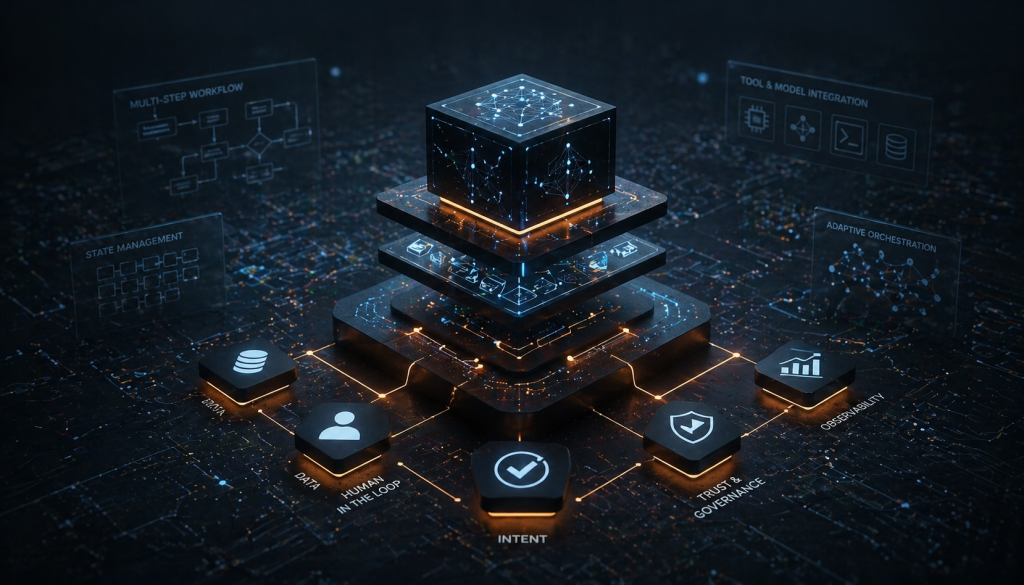
Orchestration is the layer that manages how systems operate over time. It is responsible for maintaining intent across steps, coordinating multiple components, handling failures, and determining when human input is required.
Without it, even strong individual components produce unreliable systems.
Some of the most common failure points show up quickly:
Systems lose track of intent as tasks span multiple steps.
Outputs from one component do not align cleanly with the next.
There is no clear mechanism for introducing human oversight at the right moment.
Costs increase rapidly as systems retry, loop, or over-process without coordination.
The result is not a lack of capability. It is a lack of structure.
As model capabilities continue to improve, this gap becomes more visible. Better models do not solve coordination problems. In some cases, they make them more pronounced because expectations increase.
We are moving toward a phase where model capability becomes widely available. In that environment, differentiation shifts.
The systems that succeed will not be defined by the models they use, but by how effectively those models are orchestrated.
This includes how work is routed, how state is managed, how decisions are tracked, and how humans remain part of the loop where it matters.
This is the layer that turns isolated capabilities into reliable systems.
It is also the layer that is currently underbuilt.
That is where much of the focus needs to be moving forward. ☕