
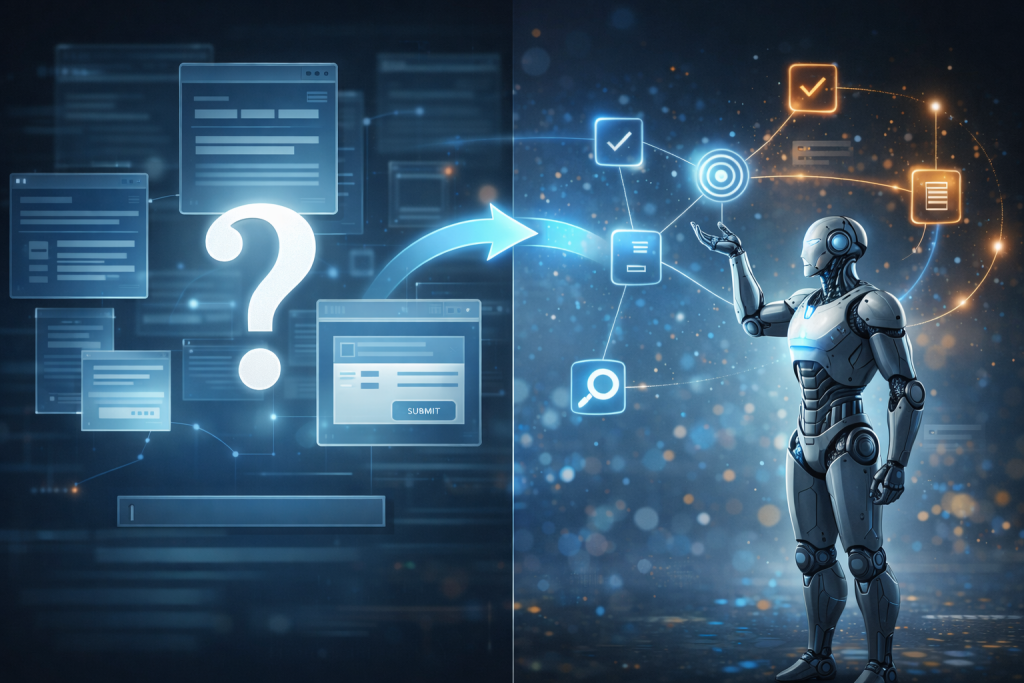
A lot of AI interfaces today are still built around the same patterns we’ve used for years.
Pages.
Forms.
Buttons.
Even when AI is involved, the experience often comes down to entering a prompt and waiting for output.
That works, but it misses something important.
It assumes the user knows what to do next.
In practice, that’s where most friction shows up.
“What am I supposed to do next?”
That question comes up again and again.
It’s not a failure of the user.
It’s a gap in the system.
This is where intent-driven UX starts to matter.
Instead of organizing around screens, you organize around outcomes.
What is the user trying to accomplish?
What is the next logical step?
What context should the system already understand?
When you design around intent, the system starts to guide instead of wait.
That has a direct impact on how AI behaves.
AI is no longer sitting behind a prompt box waiting for instructions.
It becomes part of a flow.
It receives direction from the system.
It contributes at the right time.
It operates within context instead of guessing at it.
This reduces friction in a very practical way.
Fewer pauses.
Fewer dead ends.
Fewer moments where the user has to stop and think about how to use the tool itself.
It also creates a natural feedback loop.
Every hesitation becomes a signal.
Every point of confusion becomes something you can refine.
Over time, the system aligns more closely with how users actually work.
This is where AI starts to feel less like a separate capability and more like part of the experience.
Not because the models changed.
Because the system around them did.
Intent-driven UX isn’t just a design preference.
It’s a requirement for making AI systems usable, predictable, and trustworthy at scale. ☕