
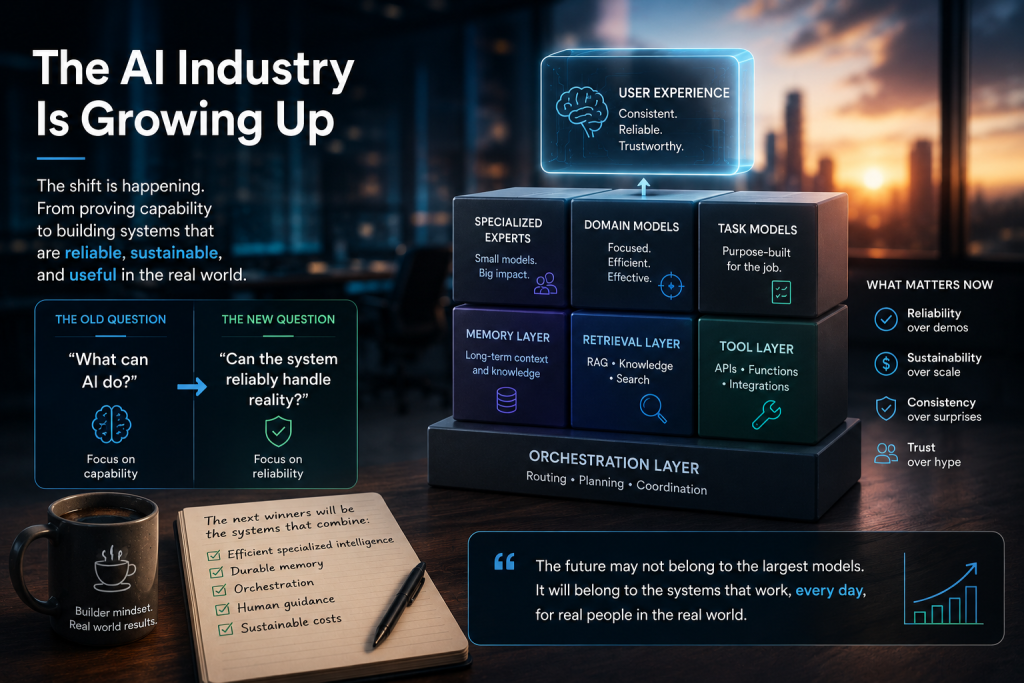
The AI industry feels different lately.
Not slower. If anything, the pace is increasing. New models, new tooling, new capabilities, new benchmarks. Every week there seems to be another leap forward.
But underneath all of that, something else is happening.
The conversation is starting to shift from capability to practicality.
For the last few years, the focus was proving that AI could do impressive things. Generate text. Write code. Create images. Hold conversations. The industry needed that phase. It pushed the boundaries of what people thought was possible.
Now we are entering a different phase.
The question is no longer:
“What can AI do?”
The question is becoming:
“How do we make these systems reliable, sustainable, and useful in the real world?”
That is a much harder problem.
Building real systems quickly exposes the gaps between demos and production reality. Context drifts. Memory breaks down. Costs scale unpredictably. Outputs become inconsistent over time. Systems that look impressive in isolated examples become fragile once they are expected to operate continuously.
That is where a lot of the real engineering work begins.
Lately I’ve been spending more time thinking about orchestration, memory layers, long-term context management, and cost-conscious model strategies than raw model capability itself. Smaller specialized systems are becoming increasingly interesting to me. Not one giant expert that tries to do everything, but many focused experts coordinated effectively.
Techniques like LoRA, retrieval-augmented generation, memory layering, and even older ideas around modular systems and evolutionary training methods are becoming more important as AI systems mature.
The future may not belong exclusively to the largest possible models.
It may belong to systems that combine:
- efficient specialized intelligence
- durable memory
- orchestration
- human guidance
- and sustainable operating costs
That is a very different optimization problem than simply maximizing benchmark scores.
In many ways, the AI industry is starting to grow up.
The excitement phase is still here, but reality is beginning to shape the conversation. Reliability matters. Cost matters. Trust matters. Systems that can operate consistently over time matter.
That shift is healthy.
Because ultimately, the systems that succeed long term will not just be the most intelligent.
They will be the ones people can actually depend on.
☕