
Most conversations about artificial intelligence begin with capability.
Can it write content? Can it summarize documents? Can it analyze data? Can it automate a process that currently requires human effort?
Those questions are important, but they are also relatively easy to answer. Modern AI systems are increasingly capable, and each new generation of tools seems to push the boundaries a little further.
The more challenging questions tend to appear after the initial excitement wears off.
Who owns the outcome? What happens when the answer is wrong? Where does the context come from? How is quality measured? When should a human review the result, and when can the process move forward automatically?
These are not questions about intelligence. They are questions about operations.
Over the past few years, I’ve noticed a pattern across organizations exploring AI. The first phase is usually experimentation. A team discovers a new tool, automates a few repetitive tasks, and sees promising results. Productivity improves in small but meaningful ways, and people begin to imagine what else might be possible.
Eventually, however, the conversation shifts.
The question is no longer whether AI can perform a task. The question becomes whether the organization can depend on it.
That transition is where many initiatives stall.
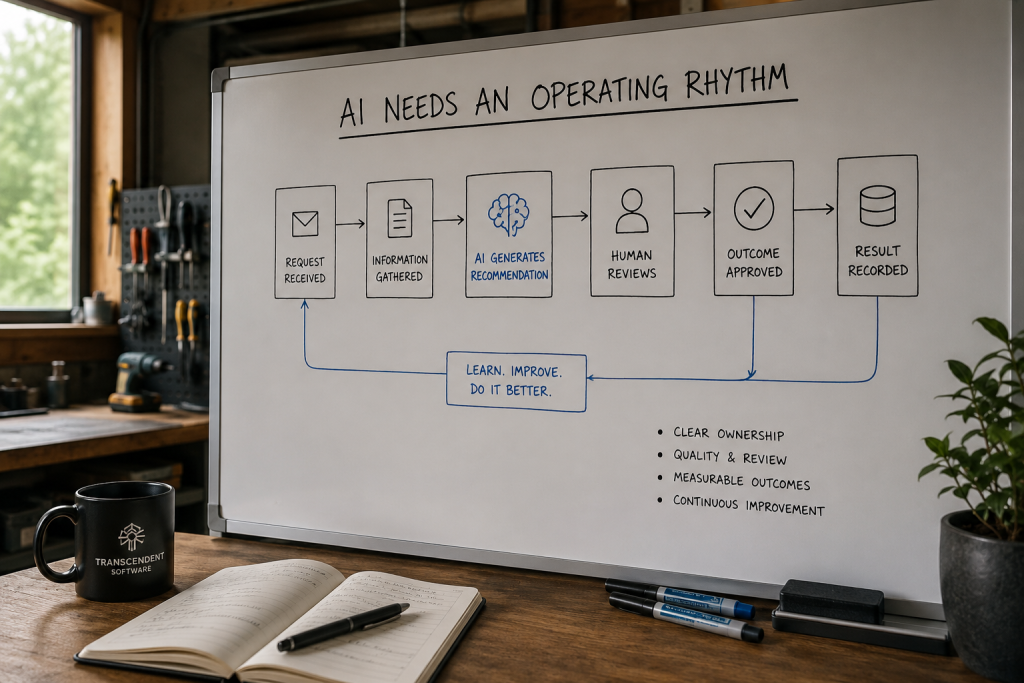
The companies that successfully integrate AI into their operations are rarely the ones chasing every new model release. More often, they are the organizations that already understand how work moves through their business. They know where requests originate, what information is required, who makes decisions, and how exceptions are handled. They have established processes, clear ownership, and measurable outcomes.
In short, they have an operating rhythm.
AI works best when it becomes part of that rhythm rather than attempting to replace it.
Consider a customer service workflow. A request arrives, relevant information is gathered, recommendations are generated, and a team member reviews the proposed response before it is sent. The outcome is recorded, lessons are captured, and future interactions benefit from that accumulated knowledge.
The value does not come from a single prompt. It comes from the system surrounding it.
This distinction is easy to overlook because prompts are visible while workflows are not. A prompt can be demonstrated in a meeting. A workflow requires a deeper understanding of how an organization actually functions. Yet workflows are ultimately what determine whether a capability becomes a reliable business process.
That is one reason I spend more time thinking about workflow than models.
The latest model may improve accuracy, speed, or reasoning, and those improvements certainly matter. However, even the most capable model will struggle to create lasting value if it operates inside a poorly defined process. Conversely, a well-designed workflow can continue delivering value even as underlying technologies evolve.
Businesses rarely need AI simply for the sake of AI. They need faster decisions, better visibility, reduced manual effort, and more consistent outcomes. Achieving those goals requires more than intelligence. It requires structure.
As AI continues to mature, I suspect the organizations that benefit most will not necessarily be the ones with access to the most advanced tools. They will be the organizations that understand how work flows through their business and have built systems that people can trust.
Intelligence creates possibilities.
Structure turns those possibilities into results.